Let me guess. You’ve opened Google Colab, typed something like “load this CSV, clean it, run a regression, give me the insights” — and watched an AI model spit out a complete, working analysis in about four minutes. Plots. Model outputs. Even a little summary paragraph at the end.
And then you sat back and thought: why am I spending months learning Python again?
It’s a fair question. Genuinely. And if anyone tells you it’s a dumb question, they haven’t been paying attention to what these systems can do. The progress is real. But the conclusion most students jump to — “therefore I don’t need to learn Python” — is where things go sideways.
So let’s do this properly. Not with vague reassurances, but with actual data and actual reasoning.
Before we get into the why, let’s establish what the job market is actually saying right now. Because ultimately, for most people reading this, the question isn’t philosophical — it’s practical.
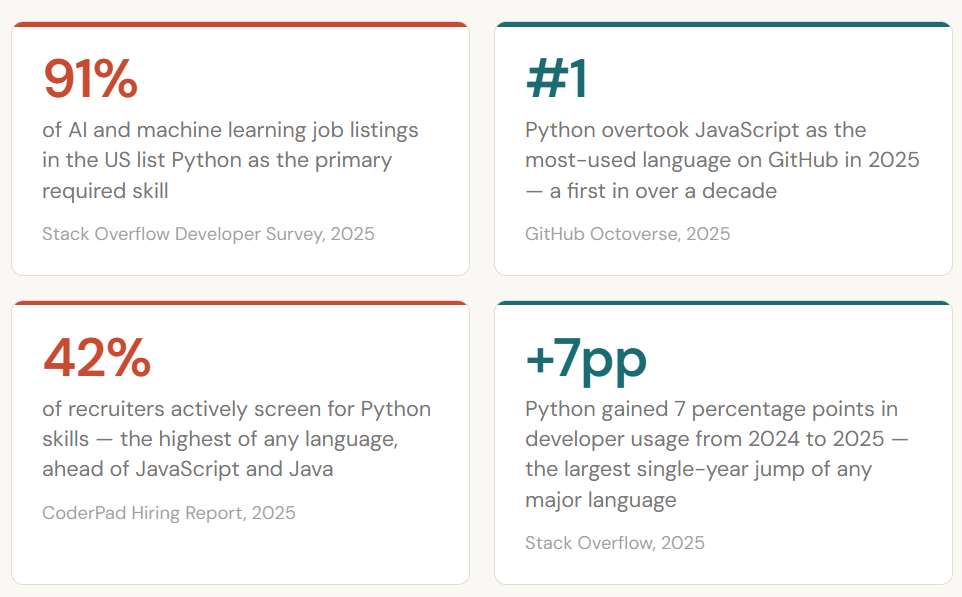
That last number is worth sitting with. In a year when everyone was saying “AI is replacing programmers,” Python usage among developers jumped more than it ever has in the language’s history. That’s not a coincidence.
What the TIOBE Index showsPython moved from rank 26 in 2001 to rank 1 in 2026 — a rise of 25 positions over 25 years. In November 2025, it hit a record 26.14% share, higher than any language has ever achieved in the index’s history. The rise of AI is the primary driver. Source: TIOBE / Codegnan, 2026 →
When a student asks “is Python still relevant?”, what they’re usually really asking is one of two things:
Option A: “Can I get a job in data science without knowing Python?” — a short-term career question.
Option B: “Is spending months learning this language a good investment of my time, given where AI is going?” — a longer-term strategic question.
Both are legitimate. And they have slightly different answers. In this piece, we’ll deal with the first one properly. The second one deserves its own article.
Let’s not undersell this. Go to Google Colab right now. Upload a dataset, drop in the Gemini model, and type something like: “Load this, check for missing values, run univariate analysis, build a random forest, and give me the key insights.”
Within three to four minutes, you’ll have plots, model metrics, and a written summary. It’s impressive. It works. And for simple, standard analytical tasks, it’s genuinely good.
“The code output from generative AI systems is often very bloated and inefficient. And for more complex situations, it fails in spectacular ways.”
A pattern observed consistently across professional data science teams in 2025
But here’s what happens when you take that AI-generated analysis into a real workplace environment:
The client dataset has encoding issues the AI didn’t flag. The model was trained on a 60/40 split instead of time-series aware splitting, which means it’s been evaluated incorrectly. The feature engineering step made an assumption about a column that’s actually categorical, not ordinal. And the “insights” paragraph confidently states something that contradicts domain knowledge any human expert would have caught immediately.
None of this means the AI tool is useless. It means someone still needs to know enough to catch these things. And that someone needs Python.
AI systems don’t take accountability. When something goes wrong downstream — a bad recommendation, a flawed model, a misread of the data — a human carries that responsibility. And the human who can actually read the code, understand what happened, and explain it to stakeholders? That person is not replaceable right now. They’re increasingly rare and increasingly well-paid.
AI-generated Python is frequently functional for simple tasks. For anything complex — custom pipelines, unusual data structures, performance-sensitive code, production systems — it tends to produce code that technically runs but is bloated, slow, and hard to maintain. Knowing how to evaluate, clean up, and optimize that output is a job. A growing one.
Every major AI coding tool — Copilot, Cursor, Gemini in Colab, Claude — is built on the model of augmenting a developer, not replacing them. The entire UX assumes you can read what it generates. Choosing the right libraries, validating outputs, structuring a project, deciding what to even ask — that all requires foundational knowledge. You can’t be the pilot without it.
Context matters enormously in data science. A model that gets 84% accuracy in testing might perform terribly in production because of data drift, population shift, or edge cases specific to your industry. AI systems don’t understand your business, your regulatory environment, or the institutional knowledge your team has built over years. A human who understands the code can make targeted adjustments that lead to significant performance improvements. That’s still deeply human work.
Generative AI is stochastic by design — run the same prompt twice and you get different outputs. For production data pipelines, ML systems, and real-time analytics, you need reproducibility and reliability. Building that on top of AI-generated code requires engineers who understand what they’re working with. This is a growing specialization, and Python is the language of that work.
Let’s get concrete. Not anecdotal — concrete.
LinkedIn currently shows over 1.19 million job listings requiring Python skills. The US Bureau of Labor Statistics projects 20% job growth for computer and information research roles between 2024 and 2034 — about twice the average for all occupations. Data-related roles are expected to double by 2026. And 60% of hiring managers in the US already report difficulty finding talent to fill data science and analytics positions.
“Python remains the default language for data work, and Stack Overflow’s survey shows Python adoption accelerating from 2024 to 2025… Employers increasingly expect analytics fluency across functions.” Read the full piece →
This isn’t a market that’s contracting. It’s a market that’s demanding higher-skilled professionals — people who understand not just how to run code, but how to think about data, design systems, and make defensible decisions. Python is the baseline. The floor, not the ceiling.
Here’s the thing that often gets missed: AI tools are increasing the demand for Python programmers in a specific way. When a product manager, a business analyst, or a marketing director can now generate a basic Python script using an AI tool, organizations are more willing to invest in data infrastructure. That raises the floor for what a dedicated data scientist or ML engineer needs to deliver. The bar goes up, not down.
There’s a version of this argument that’s worth taking seriously: “I’ll just describe what I want, let the AI write the Python, and I’ll learn just enough to understand the output.”
This is actually a reasonable approach — for some tasks. But it runs into problems quickly.
First, you can’t evaluate code you don’t understand. If the AI makes a subtle error — and it does, regularly — you need to be able to spot it. This requires knowing enough Python to read it critically.
Second, the more complex your problem, the less reliable AI-generated code becomes. Custom data transformations, API integrations, model deployment, memory optimization — these require structured problem-solving that you can’t prompt your way through without foundational knowledge.
Third, and maybe most importantly: in interviews, you’re still expected to write code. Nearly every data science role that pays well will include a technical assessment. “The AI wrote it” is not an answer you can give.
“84% of developers use AI tools despite 46% actively distrusting their accuracy. Python expertise is valuable precisely for verifying ‘almost right’ AI output.”
Stack Overflow Developer Survey, 2025 — via ByteIota Analysis
Yes. And for a reason that might surprise you: because AI made Python more important, not less.
The entire AI ecosystem — every model, every pipeline, every deployment framework — runs on Python. TensorFlow, PyTorch, scikit-learn, Hugging Face Transformers, LangChain, FastAPI. The tools being built to work with AI systems are Python tools. If anything, the explosion of AI development has expanded the Python ecosystem faster than anything that came before it.
You’re not learning Python to do what AI does. You’re learning Python so you can work alongside AI, direct it, evaluate it, and build things with it that it couldn’t build on its own.
Python is, right now, one of the easiest high-value languages to learn. Its syntax is readable. Its community is enormous. The learning resources are the best they’ve ever been. And the job market is explicitly asking for it.
Put the doubts to rest. Start learning.