
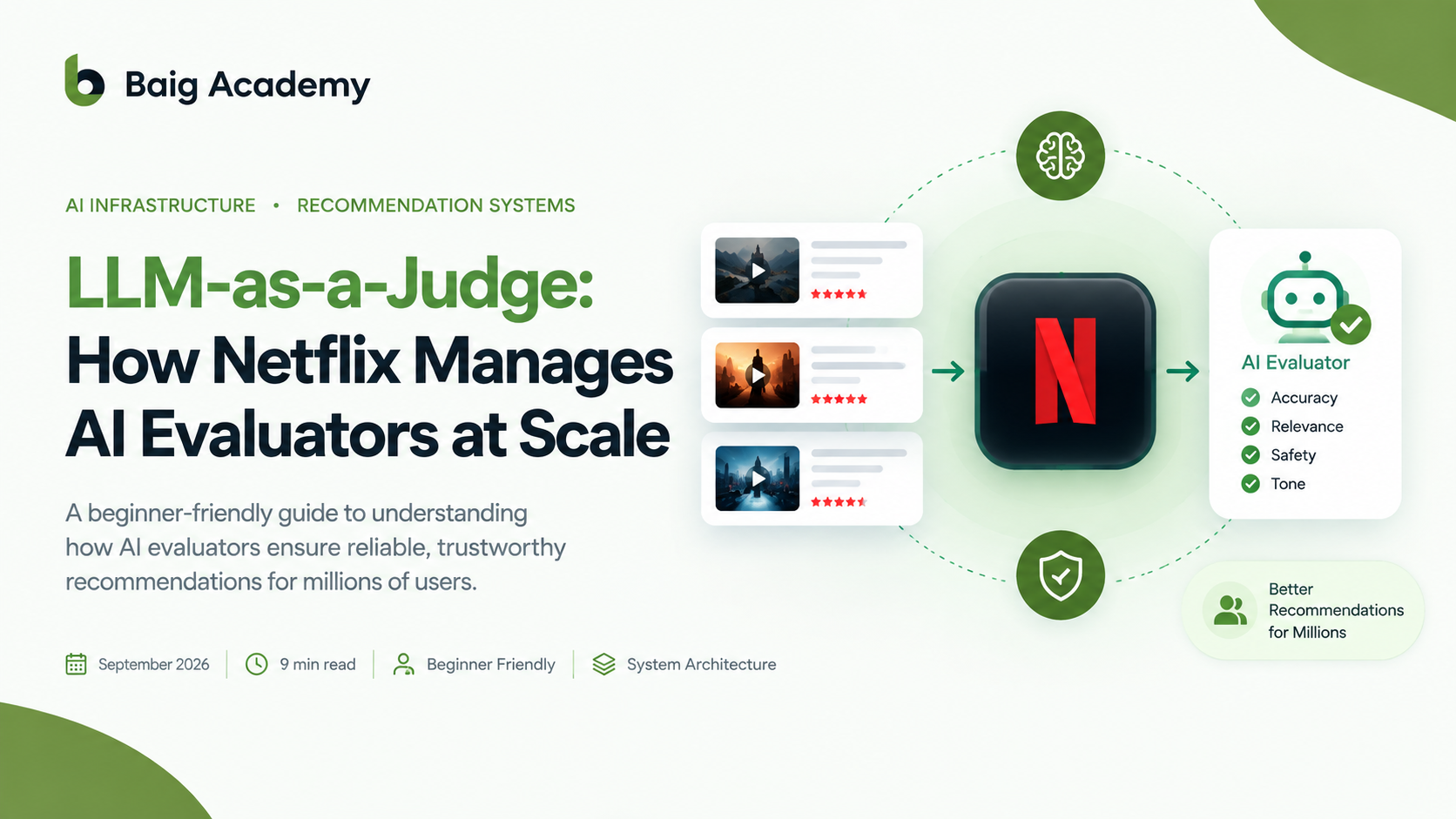
LLM-as-a-Judge: How Netflix Manages AI Evaluators at Scale
Here’s a beginner-friendly guide to understanding AI evaluators, with an extremely interesting case study from Netflix that shows us how to ensure reliable, trustworthy recommendations for millions of users.
Imagine trying to check the quality of millions of personalized movie recommendation summaries every single week. A human might do a few hundred a day; a team of humans might get to a few thousands. But millions?
Leading tech companies have been increasingly using Large Language Models (LLMs) as a “judge” to automatically and systematically review the outputs of other AI models. The idea has great merit. It sounds like a brilliant idea - and it is, in many ways - until you realize that the AI judge has some things in common with the human employee. One of them being that they simply can’t be hired and forgotten.
The AI judge needs to be continuously reviewed and updated. You need to oversee, train the AI judge as user tastes and catalogs change. The system’s performance can easily degrade otherwise, leading to bad recommendations. In this guide, we will learn how Netflix manages this challenge at scale.
1. What is an LLM-as-a-Judge? Do I really need it?
Before diving in, let’s understand what we are even looking to evaluate for Netflx and understand the problem better. When a user is recommended a piece of content, they also get a short blurb that tells them why they got that recommendation. It could be a simple note like: “A funny and warm holiday romance about love and new beginnings; much like My Secret Santa.”
Generating these highly personalized blurbs at scale typically employs Generative AI. They’re often really good summaries and only occasionally completely hallucinated! Or, sometimes the tone isn’t quite appropriate. Humans could review these, if they were low in volume. For 500,000 blurbs a day, you definitely need AI. So you use a secondary LLM with only one job - evaluate the work of the first LLM.
💡 The Quality Control Analogy
Think of the primary LLM as an eager factory worker building custom products on an assembly line. The LLM-as-a-Judge is the strict quality-control inspector standing at the end of the line, checking every single item against a rubric before it goes into a box for the customer.
2. The Problem with Static AI Evaluators
AI evaluations is a nascent field. At present, most engineering teams treat their AI judge as a static piece of software. They write a prompt, test it against a fixed set of examples, deploy it, and leave it running forever. There are two big issues with this approach:
- Drift: A static judge quickly becomes outdated. As new movies are added, user slang evolves, or the underlying AI models drift, the judge's original instructions lose their effectiveness.
- Relevance: When a judge isn't updated, it begins passing poor explanations and failing good ones. Bad AI recommendations slip right through to the end user's screen.
3. The Lifecycle of the LLM Judge in 4 Phases
To solve the static evaluator problem, researchers propose a very different approach: treating the LLM judge not as a script, but as a lifelong operational agent. This agent moves through a continuous, four-phase lifecycle: Birth, Training, Deployment, and Monitoring.
Let’s look at each of the phases in a little more detail.

4. Phase I: Birth - Establishing Rubrics and Human Benchmarks

Every judge needs a rulebook. In the "Birth" phase, human experts establish the foundational criteria for what makes a recommendation explanation acceptable.
- Accuracy: Does the explanation truthfully represent the movie's actual plot and genre?
- Item-Specificity: Is the explanation specific enough, or is it a generic statement that could apply to any movie?
- Safety & Tone: Does it avoid spoilers, harmful language, and maintain the brand's voice?
Engineers create curated benchmark datasets where humans have painstakingly labeled explanations as "Good" or "Bad," along with their rationale. This becomes the ground truth the judge will learn from.
5. Phase II: Training - Reasoning-Aligned Rubric Tuning (RART)

It isn't enough for an AI judge to simply spit out a "Pass" or "Fail" score. We need to teach the judge how to think like a human editor. This is where a technique called Reasoning-Aligned Rubric Tuning (RART) comes into play.
🧠 What is RART?
Instead of just comparing scores, a "meta-judge" analyzes the step-by-step reasoning of the primary judge. If the AI judge gives a movie explanation a "Fail," RART forces it to explain why. That reasoning is then automatically compared against the human expert's logic to refine and tune the AI's grading rubric.
6. Phase III: Deployment - Quality Gating & Reflective Generation

Once trained and aligned, the judge is deployed into production. Interestingly, a highly trained judge doesn't just block bad content—it actively improves the system through a dual-role deployment.
| Deployment Role | How It Works | Primary Benefit |
|---|---|---|
| 1. Quality Gating | Acts as a strict bouncer, blocking misleading, inaccurate, or unsafe explanations. | Protects brand reputation and user trust. |
| 2. Reflective Critic | Sends specific feedback back to the generator LLM to rewrite and fix the explanation. | Creates an automated self-correction loop, increasing overall output yield. |
7. Phase IV: Monitoring - Catching Drift with Human-in-the-Loop

The final phase ensures the system doesn't degrade over time. As pop culture shifts or new genres emerge, Data Drift occurs, causing the judge to slowly misfire.
To combat this, the system relies on Human-in-the-Loop (HITL) safeguards. The system performs continuous automated audits. When it detects that the judge's confidence is dropping or its decisions are skewing, it flags a small sample of data for human review. The humans provide fresh labels, triggering an automated re-tuning (sending the judge back to Phase II) without taking the whole system offline.
8. Check your understanding/ knowledge (for your team too!)
Question 1: Why is a static, "one-shot" AI judge inadequate for long-term production systems?
Question 2: What is the primary purpose of Reasoning-Aligned Rubric Tuning (RART)?
Question 3: How does a judge function as a "Reflective Critic" during deployment?
9. Next Steps & Advanced Deep Dives
Now that you have mastered the foundational lifecycle of AI Evaluators, explore these advanced technical deep dives on Baig Academy to take your implementation to the next level:
Designing Meta-Judge Architectures for RART
🔗 Advanced Deep Dive →Learn how to engineer the "judge of judges" to automatically extract, map, and align reasoning trajectories during model tuning.
Managing Large-Scale Online A/B Testing for AI Judges
🔗 Advanced Deep Dive →A senior engineering guide on shadow-deploying new judge versions and running statistical significance tests without risking user experience.
Advanced Human-in-the-Loop (HITL) Governance
🔗 Advanced Deep Dive →Dive deep into enterprise workflows for managing data drift alerts, sampling strategies, and integrating human labelers into CI/CD pipelines.