
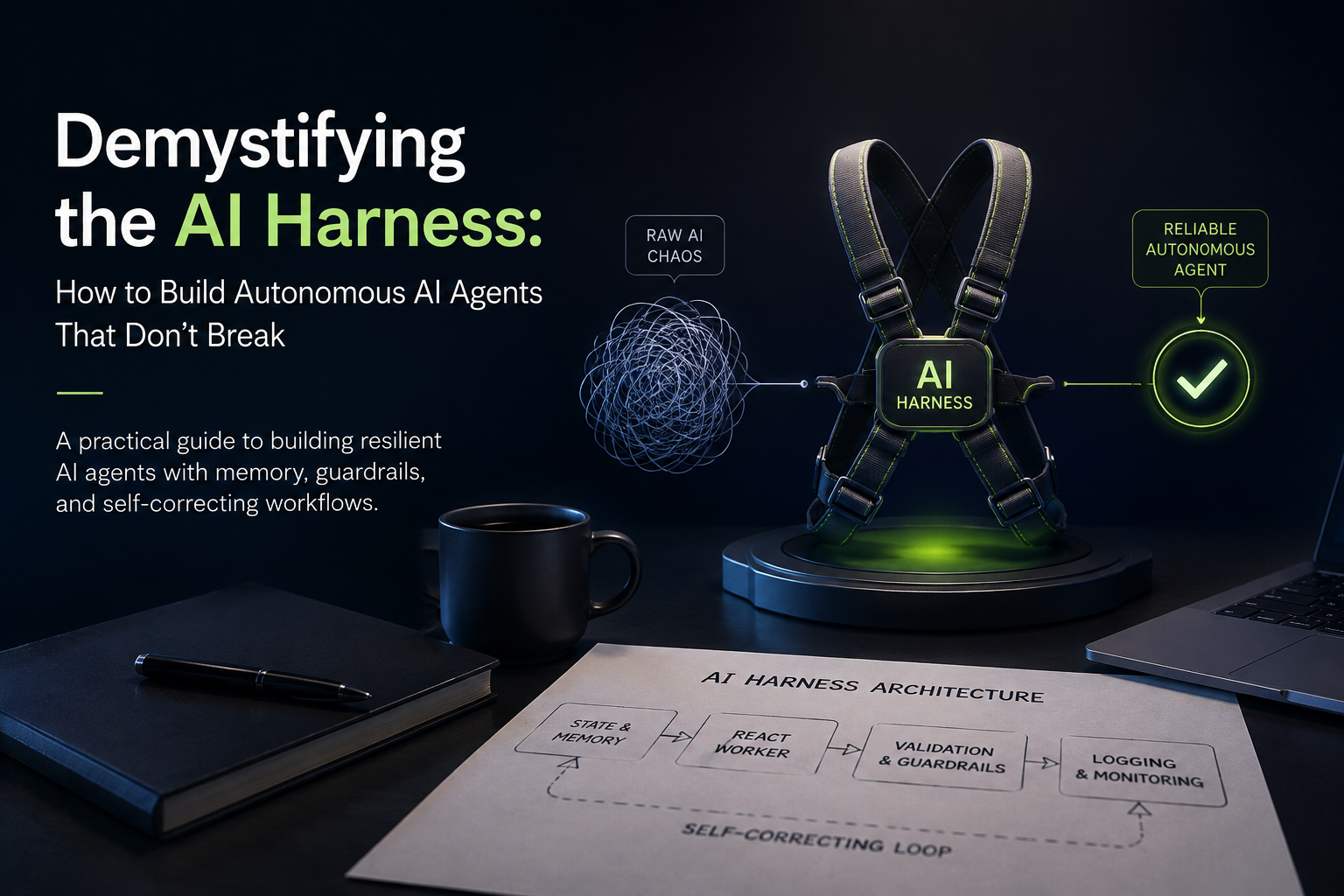
Demystifying the AI Harness: What Is an AI Agent Harness and Why Does It Matter?
A beginner-friendly guide to understanding how an AI Agent Harness gives raw AI models the memory, tools, and safety guardrails needed to run real business workflows reliably.
Imagine giving an enthusiastic intern access to your company’s email, database, and payment systems, but offering zero instructions, safety rules, or supervision. Even if that intern is extremely smart, things are bound to go wrong very quickly.
That is exactly what happens when businesses try to deploy raw Large Language Models (LLMs) directly into automated tasks. A basic chatbot might impress stakeholders during a 2-minute demo, but the moment it faces real-world edge cases—like a temporary API outage, an unexpected file format, or a complex multi-step request—it hallucinates, crashes, or gets stuck in costly infinite loops.
To turn unpredictable AI models into reliable autonomous workers, engineering teams use a crucial layer of infrastructure called an AI Agent Harness.
1. What is an AI Agent Harness?
An AI Agent Harness is the software environment surrounding an AI model. While the language model acts as the reasoning engine ("the brain"), the harness provides everything else: tools to interact with systems, memory to remember past actions, strict rules to prevent mistakes, and recovery mechanisms when things fail.
+-------------------------------------------------------------------+
|                        AI AGENT HARNESS                           |
|                                                                   |
| [ System Rules & Context ] ----> [ AI Model (Reasoning Only) ]    |
|                                         |                         |
|                                         v                         |
| [ Safe Execution Sandbox ] <--- [ Action Proposal ]               |
|          |                                                        |
|          v                                                        |
| [ Output Checks & Logs ] ------> [ Real-World Systems / APIs ]    |
+-------------------------------------------------------------------+
💡 Helpful Analogies to Keep in Mind
The Horse and the Harness: A raw LLM is like a powerful horse—it has incredible energy, but without reins, a saddle, and a harness, it cannot pull a wagon in a straight line.
The CPU vs. Operating System: As AI leaders often put it, the model is like a computer CPU (it processes calculations), while the harness is the Operating System (it manages memory, handles file access, and stops software crashes).
2. Why Do AI Agents Need a Harness?
Building an agent that works once in a controlled trial is easy. Building an agent that completes complex tasks 24/7 without crashing is a major engineering challenge known as the Reliability Gap.
- The Multi-Step Failure Problem: If an AI agent needs to perform 10 sequential actions to complete a task and has a 95% accuracy rate per step, its overall success rate drops to around 60%. At 20 steps, success drops down to roughly 36%. A harness adds verification loops to catch and fix errors before they cascade.
- Preventing Uncontrolled Retries: Without a harness, an agent hitting a network rate limit might retry the same broken action indefinitely, burning hundreds of dollars in cloud credits overnight.
- Context Management: Over long tasks, AI models accumulate clutter in their context window, causing them to forget original instructions—an issue known in the industry as context rot. The harness prunes and summarizes history to keep the AI focused.
The model is a commodity. The harness is the moat. Reliability isn't about picking a smarter model; it's about building a better harness around it.
3. The 5 Core Components of an AI Harness
While architectures vary across tech teams, most production-grade agent harnesses rely on five standard components:
- 1. Context Engineering: Actively controlling what information enters the model’s prompt at each step, summarizing long histories, and stripping unnecessary noise.
- 2. Tool Orchestration & Sandboxing: Safely managing external tools (like database lookups or web searches). The harness runs code inside isolated execution sandboxes so faulty actions cannot corrupt live databases.
- 3. Durable State & Memory: Saving progress after every completed step (checkpoint-resume). If a network failure occurs, the agent picks up right where it left off rather than starting from step one.
- 4. Schema Validation & Guardrails: Enforcing strict structured formats (using tools like Pydantic schemas) and placing Human-in-the-Loop (HITL) approval gates on high-risk actions like financial transactions or data deletion.
- 5. Observability & Trajectory Logging: Maintaining complete black-box logs (e.g., using OpenTelemetry or LangSmith) so developers can trace every decision, tool call, and reasoning step.

4. Agent Harness vs. Framework vs. Runtime
In industry discussions, terms like framework, runtime, and harness are sometimes used interchangeably, but they serve distinct roles in the software stack:
| Layer | Primary Role | Key Examples |
|---|---|---|
| Agent Framework | Provides build-time blueprints, abstractions, and prompt templates to assemble agent logic. | LangChain, CrewAI, AutoGen |
| Agent Runtime | Provides low-level execution engines, durable queues, and persistent storage. | LangGraph, Temporal |
| Agent Harness | The overarching environment governing live behavior: sandboxing, safety rules, context compaction, and error recovery. | Claude Agent SDK, OpenAI Agents SDK |
5. How a Harness Fixes Common AI Failures
When an unmanaged AI agent runs into unexpected errors, it fails catastrophically. A harness acts as a safeguard against the five most common AI failure modes:
🔄 1. Infinite Retry Loops
The Failure: An API endpoint goes down, and the AI agent repeatedly tries calling it thousands of times, wasting hundreds of dollars in API tokens.
The Harness Fix: Implements exponential backoff, maximum retry limits, and loop-detection heuristics to halt execution gracefully.
🧠 2. Context Rot & Memory Loss
The Failure: Over a 50-step task, the conversation history becomes clogged with raw error traces and outdated data, making the agent forget its original goal.
The Harness Fix: Uses active context compaction and "progress scratchpads" (e.g., updating a clean progress file) so every new step receives a fresh, compressed summary.
🛠️ 3. Tool Explosion & Confusion
The Failure: Giving an AI model 50 tools at once causes it to pick incorrect tools or generate invalid function parameters.
The Harness Fix: Enforces dynamic tool scoping, presenting only the specific tools required for the current phase of work.
⚠️ 4. Silent Output Failures
The Failure: A tool returns an empty or malformed response, but the agent assumes it succeeded and hallucinates downstream decisions based on missing data.
The Harness Fix: Wraps every tool execution in structured schema validation (like Pydantic verification) to catch failures immediately.
💾 5. State Corruption Across System Restarts
The Failure: The agent process crashes midway through a multi-step task, losing all progress and requiring a complete restart from step one.
The Harness Fix: Saves checkpoints after every successful step, allowing the agent to resume cleanly from its last verified checkpoint upon restart.
6. Real-World Harness Examples
To see how a harness operates in practice, consider two common enterprise use cases:
💻 1. Autonomous Coding Agents
When an AI coding assistant fixes a bug in a codebase, the harness does not just generate code text. It loads project context, edits files in an isolated container, executes test suites, reads error feedback if tests fail, and automatically attempts a self-correction before asking a human engineer to review the final pull request.
📊 2. Financial Data Reconciliation
In invoice processing workflows, the harness feeds records to the AI model one by one to avoid context overload. It enforces a ReAct (Reason-Act-Observe) loop, validates refund data against strict JSON schemas, and requires manager approval via Slack before applying changes to an enterprise ERP system.
7. Interactive Knowledge Check
Test your understanding of AI Agent Harness concepts with this quick 3-question review!
Question 1: What is the primary role of an AI Agent Harness?
Question 2: An agent hits an unexpected 500 Server Error while calling an external API. How should a well-designed harness handle this?
Question 3: Why is checkpoint-resume (state persistence) critical for long-running AI agents?
8. Next Steps & Advanced Deep Dives
Now that you have mastered the foundational concepts of AI Agent Harnesses, explore these advanced technical deep dives on [Baig Academy Blogs](https://baigacademy.ai/blogs/) to take your implementation to the next level:
Building Advanced State Graphs & Schemas in Agent Runtimes
🔗 Advanced Deep Dive →Learn how to design type-safe state graphs, custom Pydantic schemas, and structured payload validators for production multi-agent architectures.
Mastering ReAct Execution Nodes & Agent Memory Decay
🔗 Advanced Deep Dive →A senior engineering guide on configuring React Poker flow nodes, trajectory logging, and active context compaction to eliminate memory decay.
Enterprise Resource Management Systems (RMS) for Senior Roles
🔗 Advanced Deep Dive →Dive deep into enterprise RMS design, fine-grained access control, Human-in-the-Loop (HITL) gates, and security patterns for autonomous AI deployments.