
AI Productivity Guide
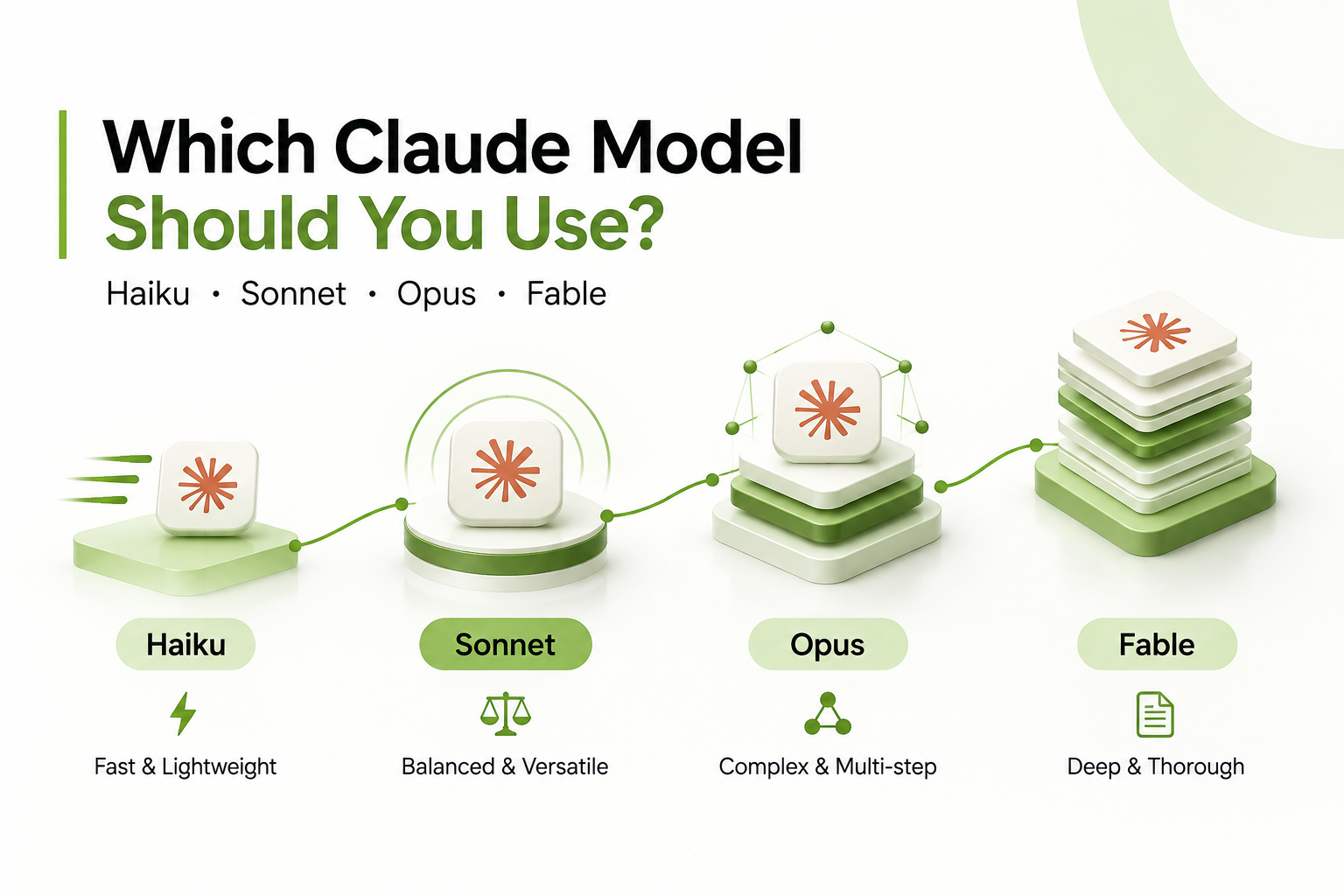
Which Claude Model Should You Use?
Claude models are designed for different kinds of work. This practical guide helps you choose between Haiku, Sonnet, Opus, and Fable based on the task in front of you, not just on technical specifications.
The models at a glance
As you move from Haiku to Fable, you generally trade some speed for more depth, context handling, and careful reasoning.
For quick questions and simple tasks
Haiku is a useful choice when the task is clear, the stakes are relatively low, and you want an answer quickly. It keeps work moving without spending extra time on problems that do not need extended analysis.
Good for:
- Fixing grammar or spelling in a short paragraph
- Getting a plain-English definition of a term
- Generating five subject line options for an email
- A one-paragraph summary of something brief
- A quick factual answer: dates, names, conversions
Keep in mind: Haiku may miss nuance. If tone, precision, or quality matters, Sonnet is usually the better choice.
Your default for most professional work
Sonnet is the practical starting point for most professionals. It is fast enough for an interactive workflow while being capable of producing structured, useful work across many business contexts.
Good for:
- Drafting emails - the kind where tone and wording matter
- Writing or editing a report, proposal, or memo
- Summarizing documents up to around 20 pages
- Researching a topic and giving you a structured answer
- Brainstorming ideas and helping you develop them
- Improving your own draft: sharper phrasing, better flow
Keep in mind: Very long documents or tasks with many interacting requirements may benefit from Opus or Fable.
For complicated problems that need careful thinking
Opus is better suited to work where the answer depends on several conditions, competing options, or a sequence of decisions. Use it when you need to understand why a recommendation makes sense, not only what the recommendation is.
Good for:
- Unpacking a legal clause or contract section in plain terms
- Comparing several vendors, plans, or options across many criteria
- Building a detailed project plan with dependencies and risks
- Pressure-testing your own thinking: "What could go wrong here?"
- Making sense of a complex policy, regulation, or set of rules
Keep in mind: Opus can be slower than Sonnet. Its additional depth is most valuable when the problem genuinely has layers.
When the work has to be exceptionally thorough
Fable is intended for work that benefits from broad synthesis, close reading, and a more complete first result. It is worth considering when the cost of missing an important detail is higher than the cost of waiting longer.
Good for:
- Analyzing a long report and pulling out what actually matters
- Synthesizing research from multiple sources into one coherent picture
- Writing something that really has to land - a pitch, a proposal, a difficult message
- Reviewing and substantially improving a large document
- Complex research where thoroughness matters more than speed
Keep in mind: For routine work, Sonnet is often sufficient. Reserve Fable for tasks where completeness and depth justify the extra time.
Still deciding?
Match your task to the model that fits it.
| Task | Starting choice |
|---|---|
| Quick factual question or grammar fix | Haiku |
| Drafting a short email or message | Sonnet |
| Writing a report, proposal, or memo | Sonnet |
| Research on a topic, standard depth | Sonnet |
| Comparing options or weighing a decision | Opus |
| Understanding a contract, policy, or regulation | Opus |
| Analyzing a long document (20+ pages) | Fable |
| Writing something important that must be really good | Fable |
| Synthesizing many sources into one document | Fable |
Automating workflows and recurring tasks
For automations, consider two questions: how often will the workflow run, and how much judgement does each run require?
| Workflow | Starting choice |
|---|---|
| Processing a high volume of short items — emails, forms, support tickets | Haiku |
| Generating the same type of document repeatedly from a template | Sonnet |
| Weekly summaries or recurring reports from consistent inputs | Sonnet |
| Automation that must make judgment calls or handle varied inputs | Opus |
| Multi-step pipelines where Claude takes several decisions in sequence | Opus |
| Automated analysis of large or complex documents | Fable |
| High-stakes outputs where automated quality must match manual quality | Fable |
Practical rule: Start with the lightest model that reliably meets your quality requirement. Test the result on representative examples, then move up when the output misses nuance, context, or important decisions.
Keep building your AI skills
Choosing the right model is only the beginning. Baig Academy shares practical AI guidance for professionals, leaders, and students who want to use these tools with more confidence.
Start with our free Claude videos on YouTube, or take a structured paid course when you are ready to go deeper.
Note: Model names, capabilities, availability, and limits can change. Confirm the current details in the Claude product documentation before publishing or relying on specific specifications.